Exploring Oak Forest: A Complete Guide to the Inner Loop's Canopy Community
Just west of the Houston Heights, across Shepherd Drive and Yale Street, lies a neighborhood that offers its own version of Inner Loop living — more land, bigger trees, and a quiet, established feel that has attracted generations of families. Oak Forest is one of Houston's largest subdivisions inside the 610 Loop, and for good reason: it combines the convenience of central Houston with the spacious, relaxed atmosphere of a mature suburban community. Here's everything you need to know about one of Houston's most beloved neighborhoods.
A Brief History
Oak Forest emerged during Houston's post-World War II housing boom, when returning veterans and their families needed affordable homes with room to grow. Developer Frank W. Sharp, who would later go on to develop Sharpstown, acquired over 1,100 acres and began platting the neighborhood in the mid-1940s. By 1947, nearly 4,780 lots had been laid out, and construction was underway.
What set Oak Forest apart from the start was Sharp's commitment to a "no two houses alike" policy. While the neighborhood's character was shaped by a consistent architectural language — mostly one-story brick ranch homes on large lots — each house had its own details, floor plan, and character. This policy gave Oak Forest a visual diversity that many postwar subdivisions lack, and it's a quality that still defines the neighborhood today.
The neighborhood was annexed by the City of Houston in the 1940s, and schools shifted from Aldine ISD to Houston ISD in 1958. Oak Forest Elementary opened its doors in 1951 and remains one of the neighborhood's cornerstones.
Character & Vibe
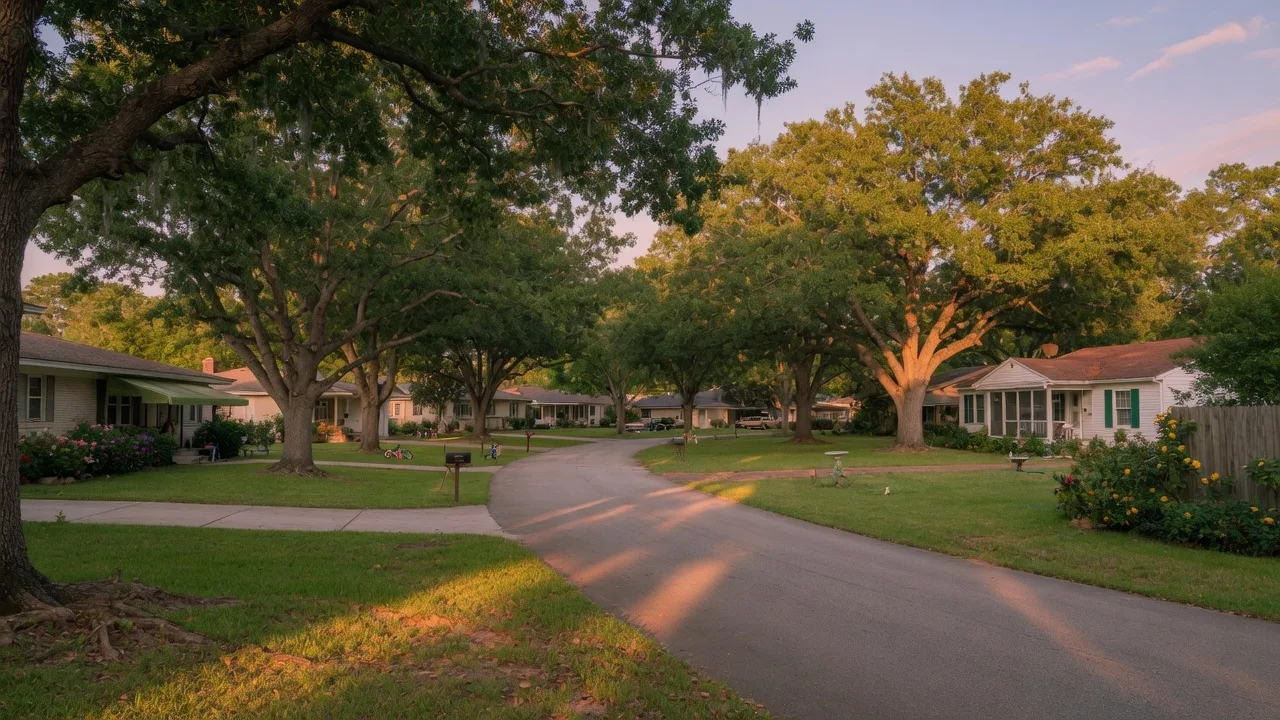
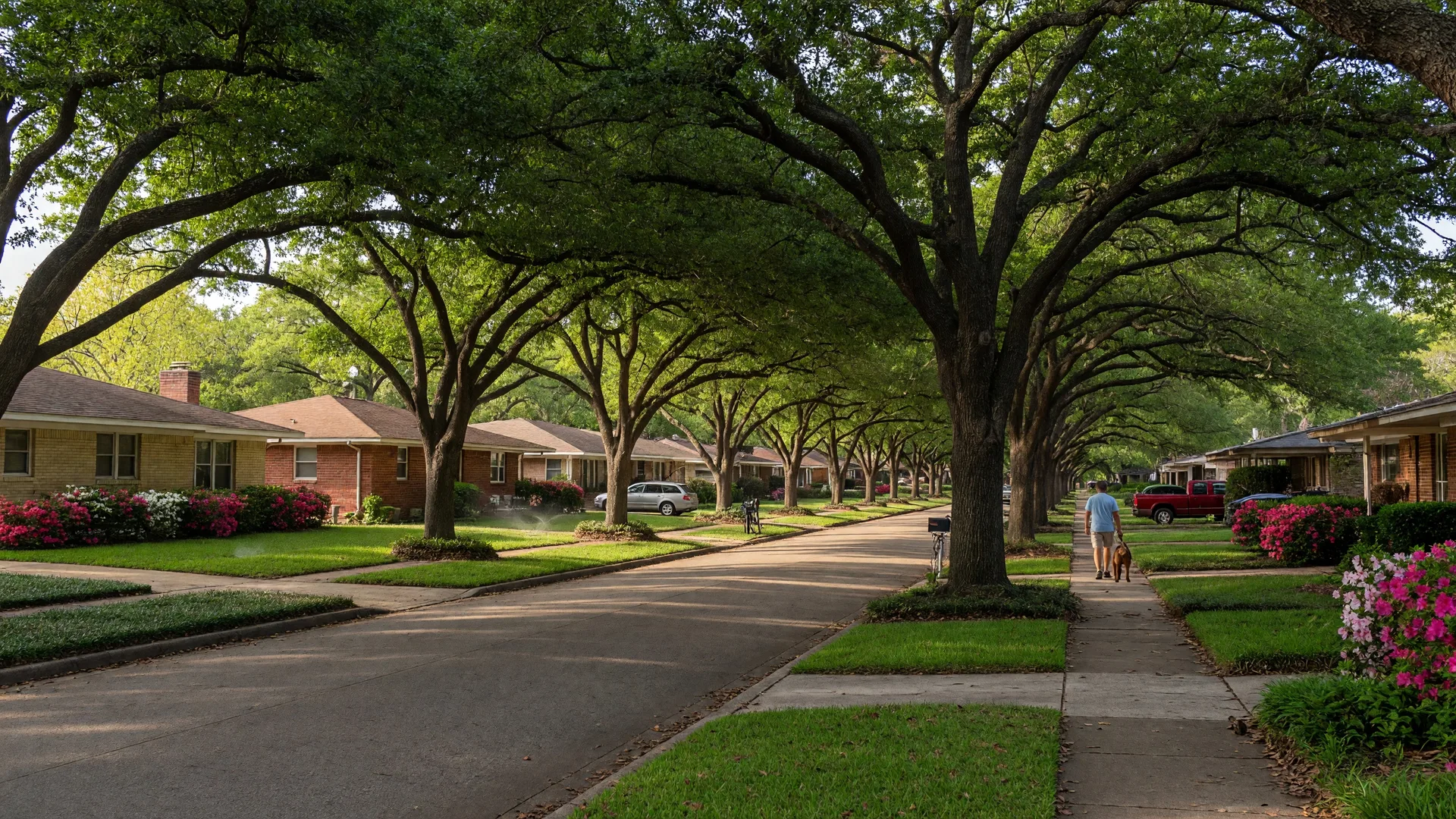
Oak Forest feels different from the Heights, and that's part of its appeal. Where the Heights is dense, walkable, and historically urban, Oak Forest is spacious, quiet, and deeply residential. Streets are wide, lots are generous (many are 7,000 square feet or larger), and the mature oak canopy that gives the neighborhood its name creates a shaded, serene environment that feels removed from the city without actually being far from it.
The neighborhood skews family-oriented — you'll see kids on bikes, neighbors walking dogs, and front-porch gatherings on mild evenings. There's a genuine small-town feel here, reinforced by a strong (and voluntary) homeowners association that organizes community events, supports local schools, and coordinates park beautification. Annual dues for the OFHA are around $40 — a modest investment for a community that punches well above its weight in neighborhood pride.
Housing & Architecture
Oak Forest's housing stock tells the story of the neighborhood's evolution. Original homes from the 1940s through 1960s are predominantly one-story, ranch-style brick houses on large lots — the quintessential mid-century Texas home. In recent years, the neighborhood has experienced significant revitalization. Older homes are being thoughtfully renovated or replaced with tasteful new construction, including larger homes of 3,000+ square feet that respect the neighborhood's established character.
This mix of original ranch homes and modern infill gives Oak Forest a dynamic, evolving feel. You'll find a well-preserved 1950s brick cottage next to a freshly built modern farmhouse — and both look entirely at home under the oak canopy. For buyers looking for more square footage and land than the Heights can offer, while staying inside the Loop, Oak Forest is one of the most compelling options in Houston.
Schools
Education is a major draw for Oak Forest families. The neighborhood is served by Houston ISD and feeds into some of the district's most sought-after schools:
- Oak Forest Elementary — Opened in 1951 and consistently rated highly, this neighborhood school is a cornerstone of the community. Its strong parental involvement and active PTA make it the kind of school where families know each other.
- Frank Black Middle School — Serves Oak Forest and surrounding areas. The school houses a Vanguard Magnet program for gifted and talented students, adding an additional academic option for families within the attendance zone.
- Waltrip High School — Opened in 1960 and serving the broader Oak Forest area. Waltrip has undergone significant improvements in recent years, including facility upgrades and expanded programming.
Several private school options also serve the area, including St. Rose of Lima Catholic School and The Awty International School, one of Houston's premier private schools located just south of the neighborhood.
Parks & Outdoor Spaces
Oak Forest has several parks within its boundaries and is a short drive from some of Houston's best green spaces. Oak Forest Park (2900 W 43rd St) is the neighborhood's hub — a multi-acre park with baseball fields, playgrounds, a pavilion, and plenty of open grass for picnics and pickup games. T.C. Jester Park sits just east of the neighborhood along White Oak Bayou and provides trail connections to the broader bayou greenway system.
For a bigger outdoor adventure, Memorial Park is about a 10-minute drive south. The park's 1,500 acres include running trails, an arboretum, a golf course, tennis center, and the recently opened Eastern Glades — a 100-acre expansion with boardwalks, a lake, and shaded walking paths. White Oak Bayou Greenway is also accessible from Oak Forest, providing a paved trail for walking, running, and cycling that connects all the way to downtown Houston and beyond.
Dining & Shopping
Oak Forest doesn't have a single concentrated commercial district like the Heights' 19th Street, but it's well-served by shopping and dining along Ella Boulevard, 43rd Street, and the nearby intersection of Shepherd Drive and 34th Street. You'll find a mix of neighborhood restaurants, coffee shops, grocery stores, and local services within a short drive from anywhere in the neighborhood.
For more dining and shopping options, the Heights' 19th Street corridor and White Oak / Yale intersection are just a five-minute drive east. Oak Forest's location between the 610 Loop, US-290, and I-45 means downtown, the Heights, Montrose, and the Galleria are all within a 15- to 20-minute drive — one of the key reasons families choose the neighborhood.
Community Life
The Oak Forest Homeowners Association is a voluntary organization that punches above its weight. With minimal annual dues, the OFHA organizes neighborhood events ranging from pub crawls and seasonal celebrations to park beautification days and community yard sales. They also serve as a collective voice for the neighborhood on land-use and development issues.
Oak Forest's community character is also shaped by quieter, organic traditions — families hosting block parties on summer evenings, neighbors gathering at Oak Forest Park on weekends, and a general culture of looking out for one another that has persisted across generations of residents. It's the kind of neighborhood where front-porch conversations still happen, where people know their mail carrier, and where a wave from a passing car is the norm rather than the exception.
Oak Forest at a Glance
- Established: Mid-1940s, post-WWII development
- Developer: Frank W. Sharp (later of Sharpstown)
- Housing: One-story brick ranch homes (original), mixed with modern new construction on generous 7,000+ sq ft lots
- Schools: Oak Forest Elementary, Frank Black Middle School (Vanguard Magnet), Waltrip High School
- Parks: Oak Forest Park, T.C. Jester Park, Memorial Park nearby
- HOA: Voluntary Oak Forest Homeowners Association (~$40/year)
- Commute: Downtown in 15–20 min via I-45, 610 Loop, or US-290
Oak Forest is sometimes described as the Heights' quieter, more spacious sibling — and there's truth to that. It shares the same commitment to community and neighborhood pride while offering a different pace and scale of living. For families who want inside-the-Loop convenience without sacrificing space, for those who value a strong neighborhood identity without the constant buzz of commercial activity, and for anyone who appreciates a good oak canopy on a summer afternoon, Oak Forest has earned its reputation as one of Houston's most desirable Inner Loop neighborhoods. Spend an afternoon driving its shaded streets, and you'll understand why so many people choose to put down roots here.

Shawn Manderscheid
Fourth-generation Houston Heights native and leader of the Shawn Manderscheid Team. Over 25 years of local knowledge and community connections.